It is always a challenge to find the right adjectives to describe a book about the Holocaust. “Enjoyable, good, and entertaining,” feel very wrong to describe a book about the atrocities and crimes of World War II. Yet, I so often feel drawn right into the storylines. Stories like The Book Thief by Markus Zusak, Number the Stars by Lois Lowry, and Echo by Pam Munoz Ryan captivate me and I have never been sure why.
Reflecting on it now, I think it is a combination of several factors.
Historical fiction as a genre often focuses on time periods that included major human struggles–think the Great Depression, the Dust Bowl, any war, the Dark Ages. Isn’t it triumph through a challenging time that makes a great story? Aside from the Covid-19 pandemic (which is starting to make its appearance at varying degrees in some new books) it is hard to think of a time in the last century that was more challenging than World War II–particularly the Holocaust. When I was a kid, I used to think that the Holocaust was ancient history. But now, as an adult, I realize that something that happened less than 100 years ago really isn’t that far removed from today.
A common theme among Holocaust literature is finding hope in the darkness and having faith that human nature is inherently good. These ideas are uplifting and optimistic, sending a strong message to the reader that even in the face of pure evil and hatred there is always a choice in how to respond.
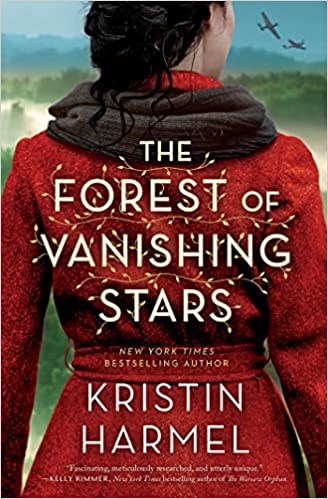
I recently read The Forest of Vanishing Stars by Kristin Harmel. It follows the story of a girl named Yona who was stolen from her crib as a toddler by a woman from the forest. This woman, named Jerusza, was one with the forest–she was able to communicate with it in ways that sometimes felt magical. She stole Yona from her crib in Berlin, Germany in the 1920s, because she could sense that Yona’s parents were evil and that Yona was destined for greatness.
Doing the math and thinking about historical context, it is easy to predict what Yona’s parents became in Germany 20 years after Yona was taken from them.
Growing up in Jerusza’s care, Yona learned how to survive in the forest. She didn’t just learn how to forage, hunt, and find shelter. She also learned how to listen to the warning signs from the forest to survive from human threats as well. This was a tool that would come in especially handy when Yona more frequently started to come across Jews fleeing into the forest to escape the Nazis.
This story was riveting, emotional, and fascinating. It kept my eyes glued to the page well past my bedtime (which is quite a feat for someone battling the exhaustion that can only be caused by teaching middle school). Yona was a heroine who made you root for her on every page, especially when she finds out more about her parents. She reminded me very much of Kya Clark, the protagonist of Where the Crawdads Sing by Delia Owens. Both are brilliant, self-sufficient women who are perfectly content to be alone, but when they experience human contact, they are forever changed.
Is Yona changed for the better? I highly recommend that you snag a copy of The Forest of Vanishing Stars to find out for yourself.
 Sibling Library